


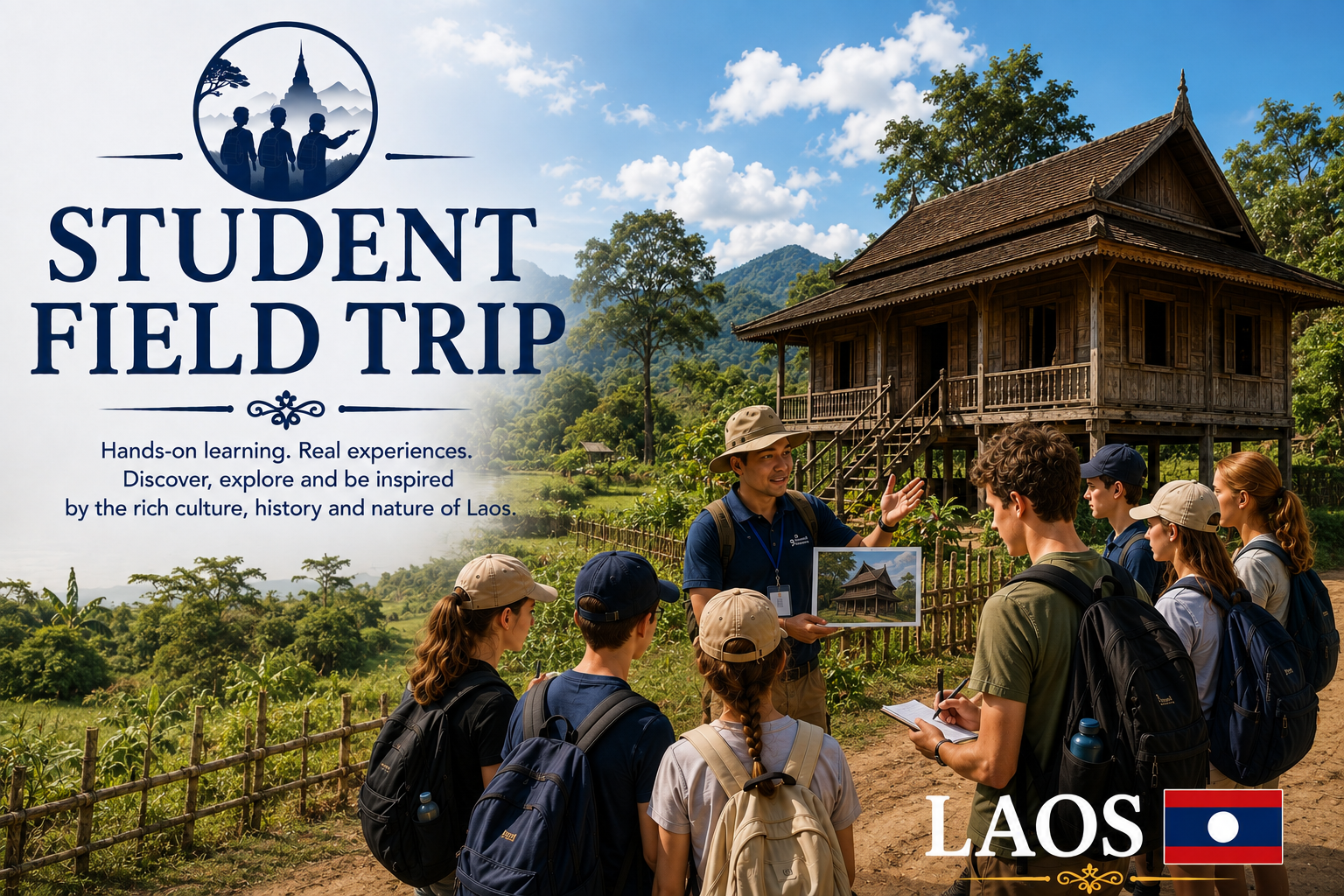
Discover the rich culture, history and natural beauty of Laos through an immersive educational journey designed for schools, colleges and universities. From the UNESCO World Heritage city of Luang Prabang to the spectacular limestone landscapes of Vang Vieng and the cultural landmarks of Vientiane, students will gain valuable insights through interactive learning, cultural exchange and real-world experiences. This carefully designed program combines history, geography, environmental studies, cultural heritage and community engagement, helping students develop global perspectives while creating lifelong memories. |
DETAILED ITINERARY
DAY 1: LUANG PRABANG ARRIVAL & ORIENTATION
Luang Prabang offers students an inspiring introduction to Laos through its UNESCO World Heritage setting, Buddhist traditions, colonial heritage and relaxed riverside life.
Learning Focus
Culture • Geography • Heritage • Cross-Cultural Awareness
Today's Learning Experience
Upon arrival at Luang Prabang International Airport, meet your local guide and transfer to the hotel.
After check-in, begin with a welcome orientation covering Lao customs, cultural etiquette, safety guidelines and an introduction to the country's geography, history and ethnic diversity.
Later, take a gentle walking tour through the historic centre. Students will observe traditional wooden houses, Buddhist temples, colonial architecture and daily life along the Mekong and Nam Khan Rivers.
In the evening, visit the colourful Night Market, where students can see local handicrafts, textiles and traditional products while learning how tourism supports small businesses and local artisans.
Learning Outcomes
Students will:
- Gain an introduction to Lao culture and geography
- Understand basic local customs and etiquette
- Observe heritage architecture and urban life
- Develop confidence in a new cultural environment
Educational Activity
Observation Journal
Students record three cultural differences and three similarities they notice between Laos and their home country.
Meals: Dinner
Accommodation: Student-Friendly Hotel in Luang Prabang
DAY 2: LUANG PRABANG HERITAGE & CULTURAL STUDIES
The UNESCO-listed town of Luang Prabang provides an ideal setting for students to explore Lao history, Buddhism, architecture and cultural preservation.
Learning Focus
History • Buddhism • UNESCO Heritage • Cultural Preservation
Today's Learning Experience
After breakfast, visit the former Royal Palace, now the National Museum, to learn about the history of the Lao monarchy and the development of modern Laos.
Continue to Wat Xieng Thong, one of the country's most important Buddhist temples, where students can examine traditional architecture, mosaics and religious symbolism.
Later, visit the Traditional Arts and Ethnology Centre to discover the cultural diversity of Laos and learn about the traditions, clothing and lifestyles of different ethnic communities.
In the afternoon, walk through the historic centre and discuss how UNESCO World Heritage status affects tourism, conservation and local communities.
Learning Outcomes
Students will:
- Understand key periods in Lao history
- Identify features of Buddhist architecture
- Recognise the cultural diversity of Laos
- Understand the importance of heritage preservation
Educational Activity
Heritage Worksheet
Students identify examples of religious, royal and colonial influence and explain why Luang Prabang is important to preserve.
Meals: Breakfast, Lunch
Accommodation: Student-Friendly Hotel in Luang Prabang
DAY 3: MEKONG RIVER FIELD STUDY & PAK OU CAVES
The Mekong River is central to the geography, economy and culture of Laos, providing students with a real-world setting to study waterways, rural communities and religious traditions.
Learning Focus
Geography • River Systems • Rural Communities • Religion
Today's Learning Experience
After breakfast, board a traditional boat for a field study along the Mekong River.
As you travel upstream, students will observe riverbank settlements, fishing activities, farmland and transport patterns while discussing the importance of the Mekong to local communities.
Arrive at the sacred Pak Ou Caves, home to thousands of Buddha images placed here over generations. Explore the caves and learn about their religious significance.
Continue to a riverside village where students can observe traditional handicrafts and compare rural life with the urban environment of Luang Prabang.
Return to town in the afternoon.
Learning Outcomes
Students will:
- Understand the role of the Mekong River in Lao society
- Identify examples of river-based livelihoods
- Learn about Buddhist pilgrimage traditions
- Compare rural and urban communities
Educational Activity
Mekong Field Notes
Students record examples of transport, agriculture, settlement and tourism observed along the river.
A short group discussion will follow:
“How does the Mekong River shape daily life in Laos?”
Meals: Breakfast, Lunch
Accommodation: Student-Friendly Hotel in Luang Prabang
DAY 4: ELEPHANT CONSERVATION & KUANG SI WATERFALLS
Today's program introduces students to wildlife conservation and environmental protection through ethical elephant care and one of Laos' most important natural attractions.
Learning Focus
Wildlife Conservation • Biodiversity • Sustainable Tourism • Environmental Science
Today's Learning Experience
After breakfast, travel to an ethical elephant sanctuary dedicated to the rescue and lifelong care of retired working elephants.
Meet conservation staff and learn about elephant behaviour, habitat protection and the importance of responsible wildlife tourism. Students will observe the elephants in their natural environment and, where permitted, accompany them on a guided forest walk without riding or performances.
After lunch, continue to the spectacular Kuang Si Waterfalls. Explore the forest trails and turquoise pools while discussing freshwater ecosystems, biodiversity and the importance of protecting natural resources.
Before returning to Luang Prabang, visit the nearby Bear Rescue Centre to learn about wildlife rehabilitation and conservation efforts in Laos.
Learning Outcomes
Students will:
- Understand the principles of ethical wildlife tourism.
- Learn about elephant conservation and habitat protection.
- Identify features of tropical forest ecosystems.
- Appreciate the importance of biodiversity conservation.
Educational Activity
Conservation Field Journal
Students record observations about elephant behaviour, forest ecosystems and sustainable tourism practices before participating in a short group discussion.
Meals: Breakfast, Lunch
Accommodation: Student-Friendly Hotel in Luang Prabang
DAY 5: HIGH-SPEED TRAIN TO VANG VIENG
Experience one of Southeast Asia's newest railway systems while exploring how modern infrastructure supports economic growth and regional development in Laos.
Learning Focus
Transportation • Engineering • Economic Development • Geography
Today's Learning Experience
After breakfast, transfer to Luang Prabang Railway Station and board the Laos–China High-Speed Railway to Vang Vieng.
During the journey, students observe the country's mountainous terrain, tunnels, bridges and changing landscapes while discussing the engineering challenges involved in constructing modern railway infrastructure.
Upon arrival in Vang Vieng, transfer to the hotel before enjoying lunch.
Later, take a guided orientation walk through the town and along the Nam Song River, where students will observe tourism development alongside traditional rural communities.
The remainder of the afternoon is free for relaxation or independent exploration with teachers.
Learning Outcomes
Students will:
- Understand the role of transport infrastructure in national development.
- Observe the relationship between geography and engineering.
- Examine tourism's impact on local communities.
- Recognise the importance of sustainable regional planning.
Educational Activity
Transport & Development Discussion
Students work in small groups to discuss how improved transport networks influence tourism, trade and community development.
Meals: Breakfast, Lunch
Accommodation: Student-Friendly Hotel in Vang Vieng
DAY 6: ENVIRONMENTAL STUDIES & COMMUNITY LEARNING
The spectacular limestone landscapes of Vang Vieng provide an outstanding outdoor classroom for studying geology, ecosystems and sustainable community development.
Learning Focus
Geology • Environmental Science • Community Development • Sustainable Tourism
Today's Learning Experience
After breakfast, visit the famous Blue Lagoon and Tham Phu Kham Cave.
Students will explore the limestone cave while learning about karst formations, erosion and the geological processes that have shaped the region over millions of years.
After lunch, continue with a gentle boat cruise or guided kayaking experience along the Nam Song River, observing river ecosystems, limestone mountains and traditional farming villages.
Later, visit a nearby rural community to learn about agriculture, local livelihoods and the benefits and challenges tourism brings to village life.
Return to the hotel during the afternoon for a reflection session.
Learning Outcomes
Students will:
- Explain how limestone karst landscapes are formed.
- Identify key features of river ecosystems.
- Understand the relationship between tourism and community development.
- Appreciate the importance of environmental conservation.
Educational Activity
Environmental Field Investigation
Working in teams, students prepare a short presentation explaining how nature, tourism and local communities can work together to support sustainable development.
Meals: Breakfast, Lunch
Accommodation: Student-Friendly Hotel in Vang Vieng
DAY 7: VIENTIANE HISTORY & CULTURAL DISCOVERY
As the capital of Laos, Vientiane offers students the opportunity to explore the country's political, cultural and religious heritage while understanding its development as a modern Southeast Asian nation.
Learning Focus
History • Buddhism • Government • Cultural Heritage • Urban Development
Today's Learning Experience
After breakfast, depart Vang Vieng and travel to Vientiane, enjoying scenic views of rural villages and agricultural landscapes along the way.
Upon arrival, begin your educational city tour with a visit to Pha That Luang, the national symbol of Laos and one of the country's most important Buddhist monuments. Continue to Patuxai Victory Monument, where students can learn about Laos' independence and enjoy panoramic views of the capital.
After lunch, visit Wat Sisaket, the oldest surviving temple in Vientiane, followed by Haw Phra Kaew, home to an impressive collection of Buddhist art and religious artefacts.
The final visit of the day is the COPE Visitor Centre, where interactive exhibitions provide valuable insight into the impact of unexploded ordnance (UXO) and the ongoing humanitarian efforts supporting affected communities.
Learning Outcomes
Students will:
- Understand the historical development of modern Laos.
- Explore the importance of Buddhism in Lao society.
- Recognise the cultural significance of national monuments.
- Appreciate humanitarian efforts supporting sustainable community development.
Educational Activity
History & Heritage Discussion
Working in groups, students discuss how religion, history and national identity have shaped modern Laos and compare these influences with those of their own country.
Meals: Breakfast, Lunch
Accommodation: Student-Friendly Hotel in Vientiane
DAY 8: REFLECTION SESSION & DEPARTURE
The final day provides students with an opportunity to reflect on their educational experiences, celebrate new friendships and consolidate the knowledge gained throughout their journey in Laos.
Learning Focus
Reflection • Global Citizenship • Leadership • Personal Development
Today's Learning Experience
After breakfast, gather for a final reflection session led by teachers and tour leaders.
Students are encouraged to share their favourite experiences, discuss the cultural similarities and differences they observed, and reflect on how travel has broadened their understanding of Laos, its people and its environment.
Depending on departure time, enjoy a short visit to a local market where students may purchase souvenirs and interact with local vendors before transferring to Wattay International Airport for the departure flight.
Bid farewell to Laos as your educational journey comes to a successful conclusion.
Learning Outcomes
Students will:
- Reflect on their educational experiences and personal growth.
- Demonstrate greater cultural awareness and global understanding.
- Recognise the value of experiential learning beyond the classroom.
- Develop confidence in communicating across cultures.
Educational Activity
Learning Reflection & Certificate Presentation
Students complete a reflection worksheet summarising the knowledge and skills gained during the program. Schools may conclude the tour with a Certificate of Participation presentation recognising each student's successful completion of the Laos Student Field Trip.
Meals: Breakfast
