


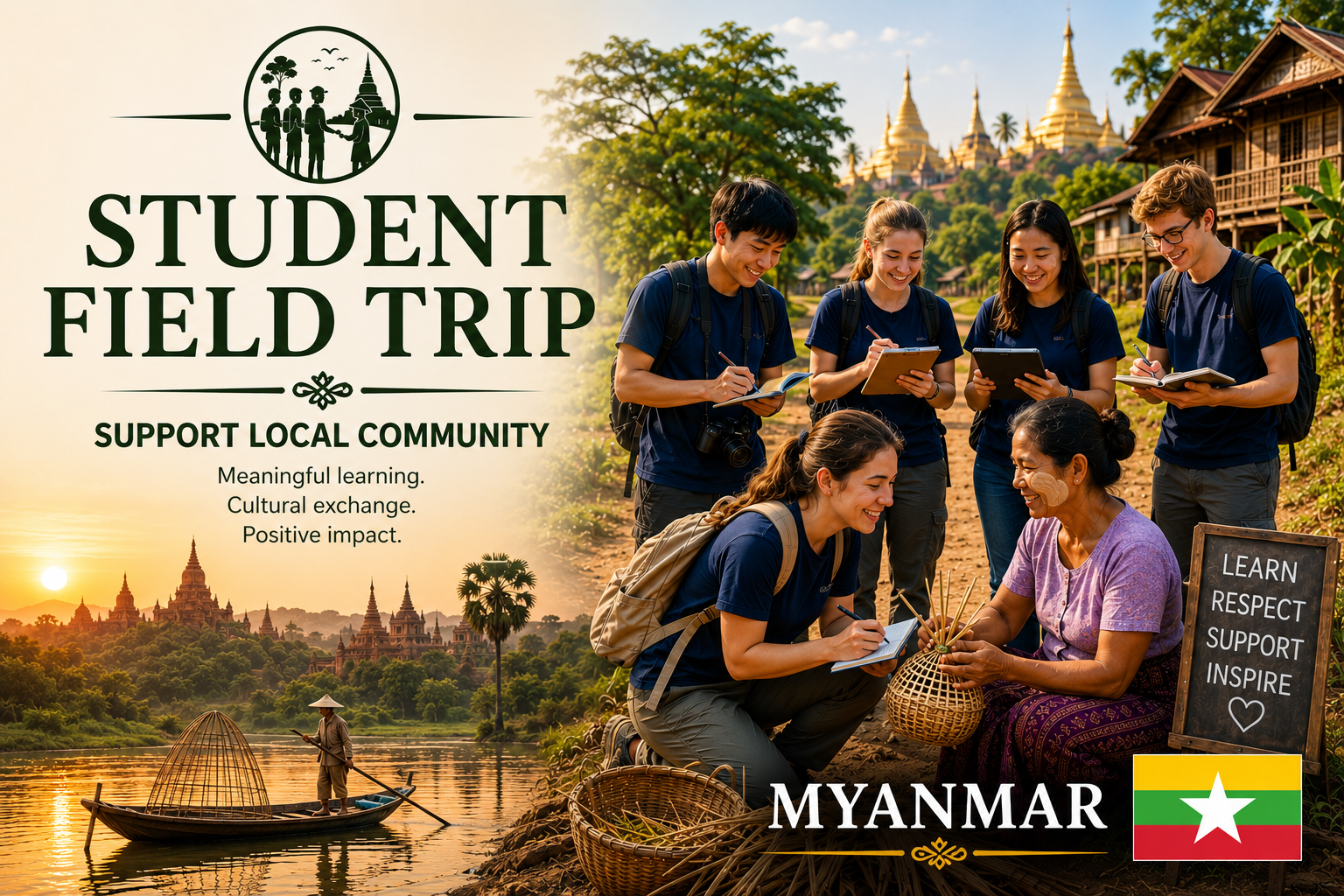
Discover Myanmar beyond the classroom on an educational journey designed for secondary school and university student groups. This 10-day Student Field Trip combines history, archaeology, religion, environmental studies, traditional craftsmanship, community life and cultural exchange. Rather than simply visiting tourist attractions, students are encouraged to observe, investigate, discuss and reflect on what they experience. From studying Buddhist heritage and urban life in Yangon to exploring the ancient civilisation of Bagan and investigating the unique floating communities and ecosystems of Inle Lake, the program connects travel with meaningful learning. The itinerary also includes hands-on workshops, interaction with local communities, group reflection sessions and opportunities for students to develop teamwork, intercultural understanding and responsible travel awareness. |
DETAILED ITINERARY
DAY 1 – ARRIVAL IN YANGON & PROGRAM ORIENTATION
Description: Welcome to Myanmar and begin the educational journey with an introduction to the country, its people and its cultural diversity.
Arrive at Yangon International Airport.
Meet your educational tour coordinator and local guide before transferring to your hotel.
After check-in, allow students time to rest and settle in.
Later, gather for a program orientation and welcome session.
Students receive an introduction to Myanmar's geography, history, ethnic diversity, religions, customs and contemporary society.
The tour coordinator will also explain cultural etiquette, responsible travel practices, health and safety procedures and expectations for the field study.
Enjoy a welcome dinner together.
Learning Focus
- Myanmar geography and society
- Cultural awareness
- Responsible travel
- Intercultural communication
- Program orientation and safety
Meals: Dinner
Overnight in Yangon.
DAY 2 – YANGON HERITAGE, RELIGION & URBAN STUDIES
Description: Use Yangon as a living classroom to explore religion, architecture, urban development and cultural identity.
After breakfast, begin an educational exploration of Yangon.
Walk through selected areas of the historic centre, observing architecture, street life, religious buildings and local businesses.
Students investigate how different periods of history have influenced the development and character of the city.
Visit the impressive Chaukhtatgyi reclining Buddha before continuing to the magnificent Shwedagon Pagoda.
At Shwedagon, students learn about Buddhist beliefs, religious practices, symbolism and the importance of pagodas in Myanmar society.
Students are encouraged to record observations and questions in their field journals.
Learning Focus
- Urban geography
- Architecture and heritage
- Buddhism and religious practices
- Cultural identity
- Observation and field research
Meals: Breakfast, Lunch, Dinner
Overnight in Yangon.
DAY 3 – MARKETS, FOOD CULTURE & HANDS-ON LEARNING
Description: Explore the relationship between food, agriculture, trade and everyday culture through an interactive learning experience.
Begin the morning at a local market.
Working in small groups, students observe locally grown fruits, vegetables, herbs, spices and other products.
The guide introduces the relationship between agriculture, food production, markets and daily life.
Continue with a hands-on Myanmar cooking workshop.
Students work together to prepare selected traditional dishes while learning about local ingredients, cooking techniques and food traditions.
After enjoying their creations for lunch, participate in a short group discussion comparing Myanmar food culture with students' own communities.
Learning Focus
- Food and culture
- Local agriculture
- Market economics
- Nutrition and ingredients
- Teamwork and practical learning
Meals: Breakfast, Lunch, Dinner
Overnight in Yangon.
DAY 4 – YANGON TO BAGAN & ANCIENT CIVILISATION
Description: Journey to Bagan and begin investigating one of Southeast Asia's most remarkable ancient cultural landscapes.
Transfer for the journey to Bagan using the most suitable operating connection.
Upon arrival, transfer to your hotel and enjoy lunch.
In the afternoon, begin exploring the Bagan Archaeological Zone.
Rather than simply viewing temples, students examine how architecture, religion, politics and engineering contributed to the development of this ancient civilisation.
The guide introduces the rise of the Bagan Kingdom and explains why thousands of Buddhist monuments were constructed across the landscape.
Students complete observation tasks comparing different temple structures and architectural features.
Learning Focus
- Ancient civilisation
- Archaeology
- Architecture
- Buddhism
- Historical interpretation
Meals: Breakfast, Lunch, Dinner
Overnight in Bagan.
DAY 5 – BAGAN ARCHAEOLOGY & HERITAGE CONSERVATION
Description: Investigate how ancient monuments are studied, protected and preserved for future generations.
Spend the morning exploring a carefully selected group of Bagan's temples and archaeological sites.
Students examine construction methods, religious artwork, architectural design and the relationship between monuments and the surrounding landscape.
Discuss the challenges involved in conserving centuries-old structures exposed to weather, earthquakes, tourism and environmental change.
Continue to a traditional lacquerware workshop.
Meet local craftspeople and observe the detailed process required to produce traditional lacquerware.
Students learn how cultural heritage includes not only monuments but also skills and knowledge passed between generations.
Return to the hotel for a break during the warmer part of the afternoon.
Later, gather for a short student reflection session.
Learning Focus
- Archaeology
- Heritage conservation
- Traditional craftsmanship
- Sustainable tourism
- Intangible cultural heritage
Meals: Breakfast, Lunch, Dinner
Overnight in Bagan.
DAY 6 – RURAL MYANMAR & COMMUNITY LEARNING
Description: Step beyond the archaeological sites to investigate agriculture, livelihoods and everyday life in rural Myanmar.
Travel into the countryside surrounding Bagan.
Visit a traditional rural community and observe agricultural landscapes, homes, local industries and village infrastructure.
Students learn about farming practices, water availability and the ways families generate income.
Where appropriate and arranged in advance, meet members of the community for a cultural exchange session.
Students can ask respectful questions about education, family life, occupations and changes affecting rural communities.
Activities should be organised collaboratively with local partners so the experience benefits the host community rather than treating the village as a sightseeing attraction.
After lunch, return to Bagan.
Conduct a group reflection comparing rural and urban lifestyles observed during the trip.
Learning Focus
- Rural livelihoods
- Agriculture
- Community development
- Cultural exchange
- Responsible tourism
Meals: Breakfast, Lunch, Dinner
Overnight in Bagan.
DAY 7 – BAGAN TO INLE LAKE & ENVIRONMENTAL INTRODUCTION
Description: Travel from Myanmar's dry central region to the distinctive wetland environment of Inle Lake.
Depart Bagan and continue toward the Inle Lake region using the most appropriate transport connection.
During the journey, students are encouraged to observe changes in topography, vegetation, agriculture and climate.
Upon arrival, transfer to your hotel.
Later, participate in an introductory session about the Inle Lake environment.
Discuss how communities have adapted their homes, transportation, agriculture and livelihoods to living around a large freshwater ecosystem.
Students prepare questions and observation tasks for the following day's field study.
Learning Focus
- Physical geography
- Freshwater ecosystems
- Human adaptation
- Environmental observation
- Sustainable communities
Meals: Breakfast, Lunch, Dinner
Overnight at Inle Lake.
DAY 8 – INLE LAKE ENVIRONMENTAL FIELD STUDY
Description: Turn Inle Lake into an outdoor classroom to study wetlands, floating agriculture and human adaptation.
After breakfast, board private boats for an educational exploration of Inle Lake.
Observe villages built on stilts and investigate how architecture has adapted to the lake environment.
Continue to the famous floating gardens.
Students learn how local farmers cultivate crops on the lake and discuss the relationship between agriculture, water resources and local livelihoods.
Observe traditional fishing practices and water-based transportation.
Visit selected artisan communities to discover traditional weaving and other local industries.
Throughout the day, students record observations about the interaction between people and the natural environment.
Learning Focus
- Wetland ecology
- Floating agriculture
- Human-environment interaction
- Sustainable livelihoods
- Environmental challenges
Meals: Breakfast, Lunch, Dinner
Overnight at Inle Lake.
DAY 9 – COMMUNITY, TRADITION & STUDENT FIELD PROJECT
Description: Bring together the lessons of the journey through cultural investigation, teamwork and student-led field research.
Begin with a visit to a local market when operating.
Students work in small groups on a simple field research project.
Possible topics include local food systems, traditional occupations, tourism, transportation, handicrafts, environmental adaptation or differences between rural and urban life.
Continue to an artisan community where students can observe traditional production methods and, when available, participate in an appropriate hands-on activity.
In the afternoon, return to the hotel.
Each student group prepares a short presentation summarising what they observed and learned.
Finish with a group reflection discussing how tourism can contribute positively to cultural preservation and local communities while also creating challenges.
Learning Focus
- Field research
- Critical thinking
- Teamwork
- Cultural preservation
- Sustainable tourism
- Presentation skills
Meals: Breakfast, Lunch, Dinner
Overnight at Inle Lake.
DAY 10 – RETURN TO YANGON & DEPARTURE
Description: Conclude the field trip by reflecting on the connections between history, culture, communities and the environment.
After breakfast, depart the Inle Lake region for Yangon using the most appropriate operating connection.
Depending on the departure flight schedule, enjoy lunch before continuing to the airport.
During the final journey, students participate in a closing reflection.
Discuss some of the major questions explored during the program:
How does geography influence the way people live?
Why is cultural heritage important?
How can ancient monuments be preserved?
How have communities adapted to different environments?
What responsibilities do travellers have toward the places they visit?
Students are encouraged to identify one experience that changed or expanded their understanding of Myanmar and Southeast Asia.
Transfer to Yangon International Airport for the onward flight.
Learning Focus
- Reflection and evaluation
- Global citizenship
- Cultural understanding
- Environmental responsibility
- Connecting classroom learning with real-world experience
Meals: Breakfast, Lunch
End of Educational Field Study.
EDUCATIONAL HIGHLIGHTS
- Study Buddhism and cultural identity at Shwedagon Pagoda
- Investigate Yangon's architecture and urban development
- Explore a traditional market and participate in a cooking workshop
- Study the ancient civilisation and archaeology of Bagan
- Examine heritage conservation and traditional craftsmanship
- Meet rural communities and learn about agriculture and livelihoods
- Compare Myanmar's dry-zone and freshwater environments
- Conduct an environmental field study on Inle Lake
- Investigate floating agriculture and human adaptation
- Meet traditional artisans
- Complete a student field research project
- Develop observation, teamwork and presentation skills
- Encourage responsible tourism and global citizenship
- Participate in daily reflection and experiential learning
KEY STUDY THEMES
History & Archaeology: Bagan Kingdom, ancient architecture and heritage conservation.
Geography & Environment: Landscapes, wetlands, water resources and human adaptation.
Culture & Religion: Buddhism, traditions, food, craftsmanship and everyday life.
Sustainability: Tourism, environmental challenges, cultural preservation and local livelihoods.
Personal Development: Leadership, teamwork, observation, intercultural communication and global citizenship.